ClearStream : Compliance Management
Product | Sustainability | B2B Waste Tracking Platform
Product
Web App
Role
Product Designer / Manager
Time Duration
6 Weeks
Description
ClearStream was designed to solve a gap that sits at the intersection of operations and compliance: commercial office buildings pursuing sustainability certifications have no dedicated tool for tracking waste performance. They manage it with spreadsheets, receive hauler data weeks late, and lack the resin-level plastics breakdown that LEED auditors actually require. This case study documents the research, design decisions, and product thinking behind a platform built to close that gap.
Problem Statement
Operations managers at commercial office buildings pursuing sustainability compliance certification have no dedicated tool for tracking waste performance. They manage compliance with spreadsheets, rely on hauler PDFs that arrive weeks late, and cannot get plastics data broken down by resin type to enable recycling efforts.
Research Insights & Design Implications
Real-time visibility does not exist
>>
Design
Implication
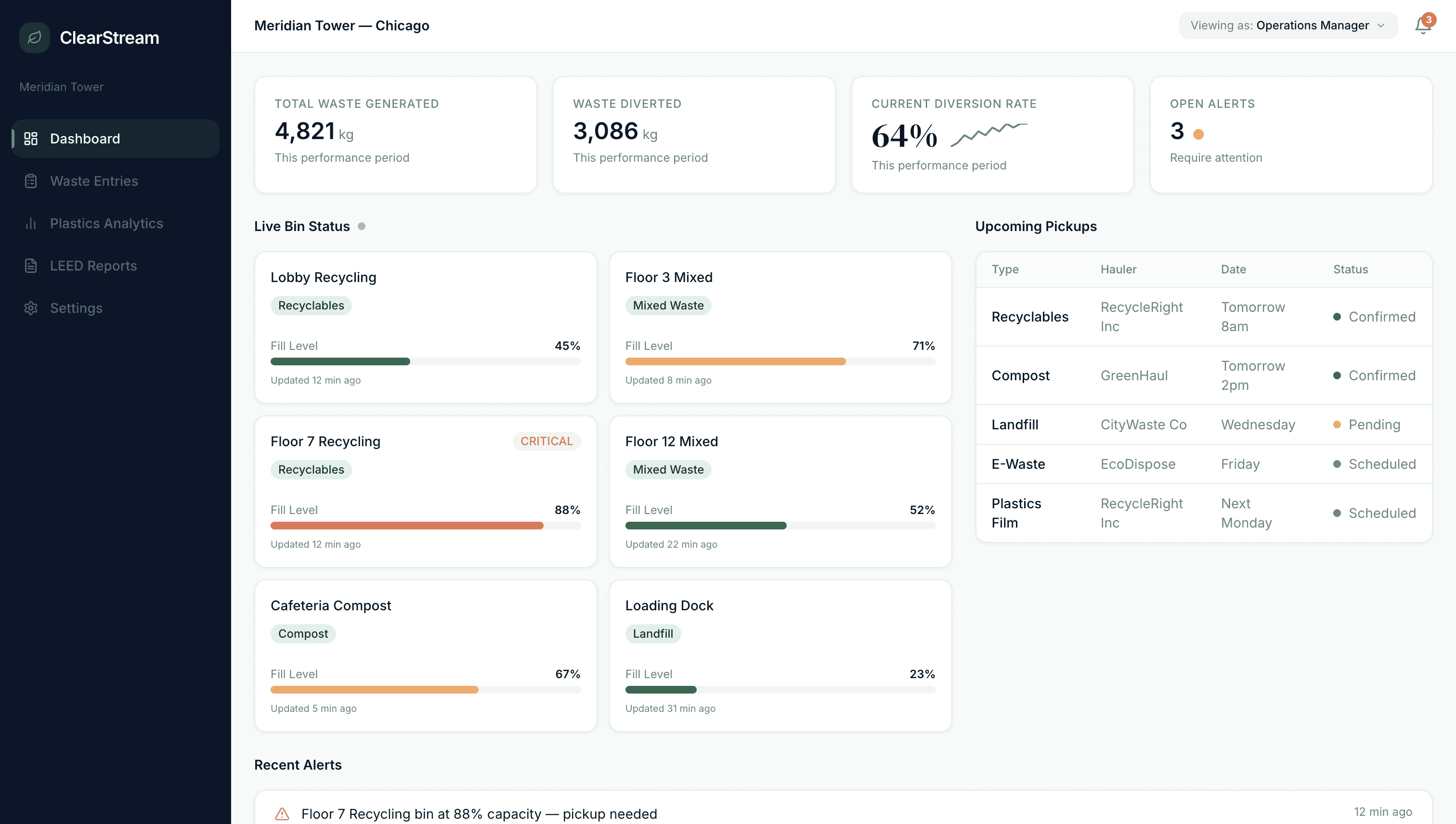
The platform must process IoT sensor data and hauler integration feeds continuously and surface diversion rate progress in real time, not at the end of a reporting cycle. The dashboard must answer 'are we on track?' at any moment during the performance period.
Plastics data is fatally coarse
>>
Design
Implication
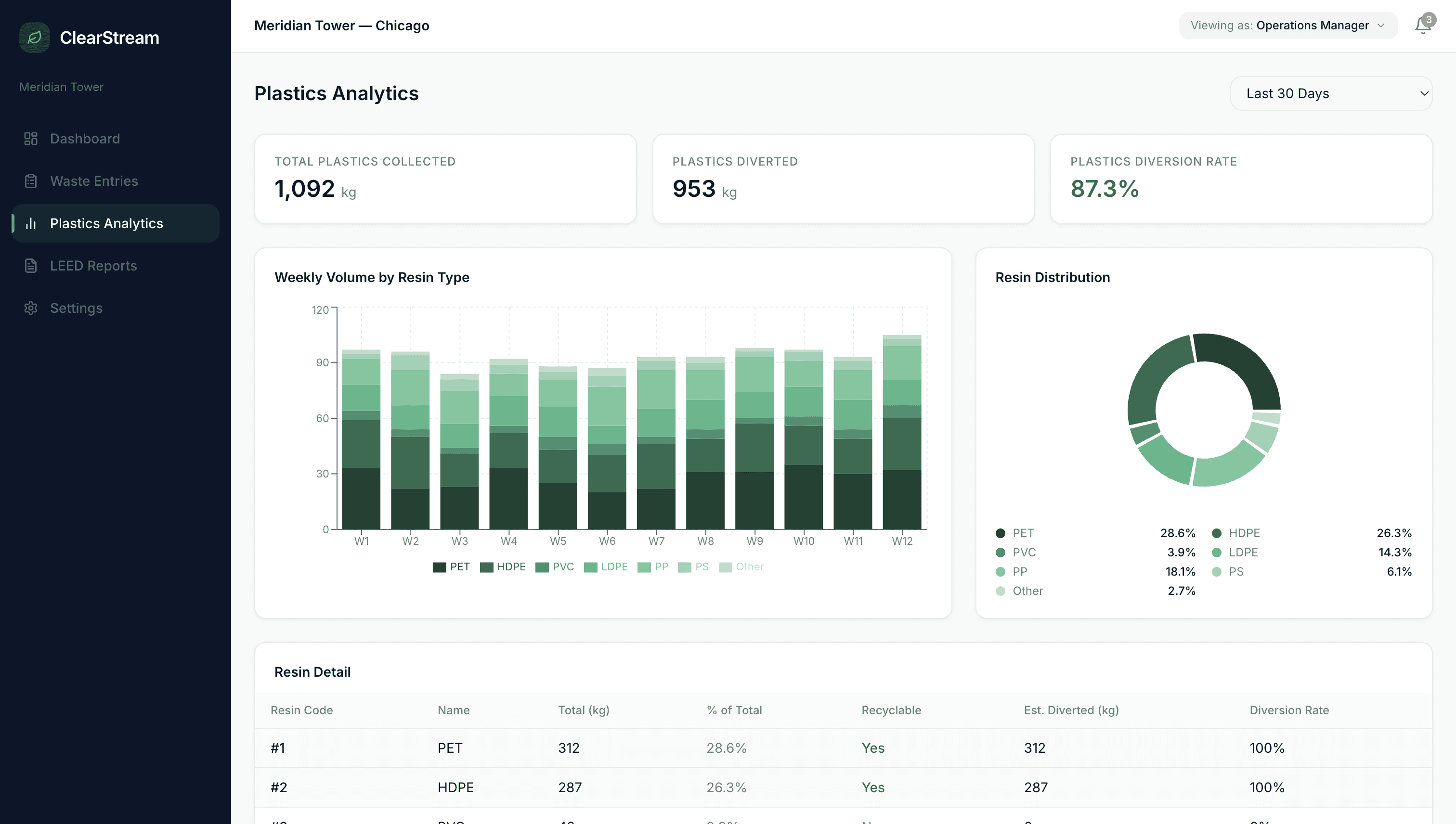
Plastics must be tracked at the resin code level (#1 PET through #7 Other) from the point of collection. Each resin must be tagged with recyclability status so the platform can calculate a true plastics diversion rate, distinguishing between recyclables and non-recyclables in the waste stream.
Reports are manual, error-prone
>>
Design
Implication
Multi-channel intake creates data fragmentation
>>
Design
Implication
The platform must normalize all data inputs into a single unified model regardless of source. IoT feeds and hauler integrations must map to a consistent waste type taxonomy. Discrepancies between sensor estimates and hauler tonnage must be surfaced for review and not silently reconciled.
Sustainability officers lack a compliance progress view
>>
Design
Implication
The sustainability officer dashboard must include a living documentation checklist that shows, in real time, which compliance requirements are met, which are in progress, and which are missing data. The checklist should function as an audit preparation tool throughout the performance period not only at submission time.
Feature Development & User Flows
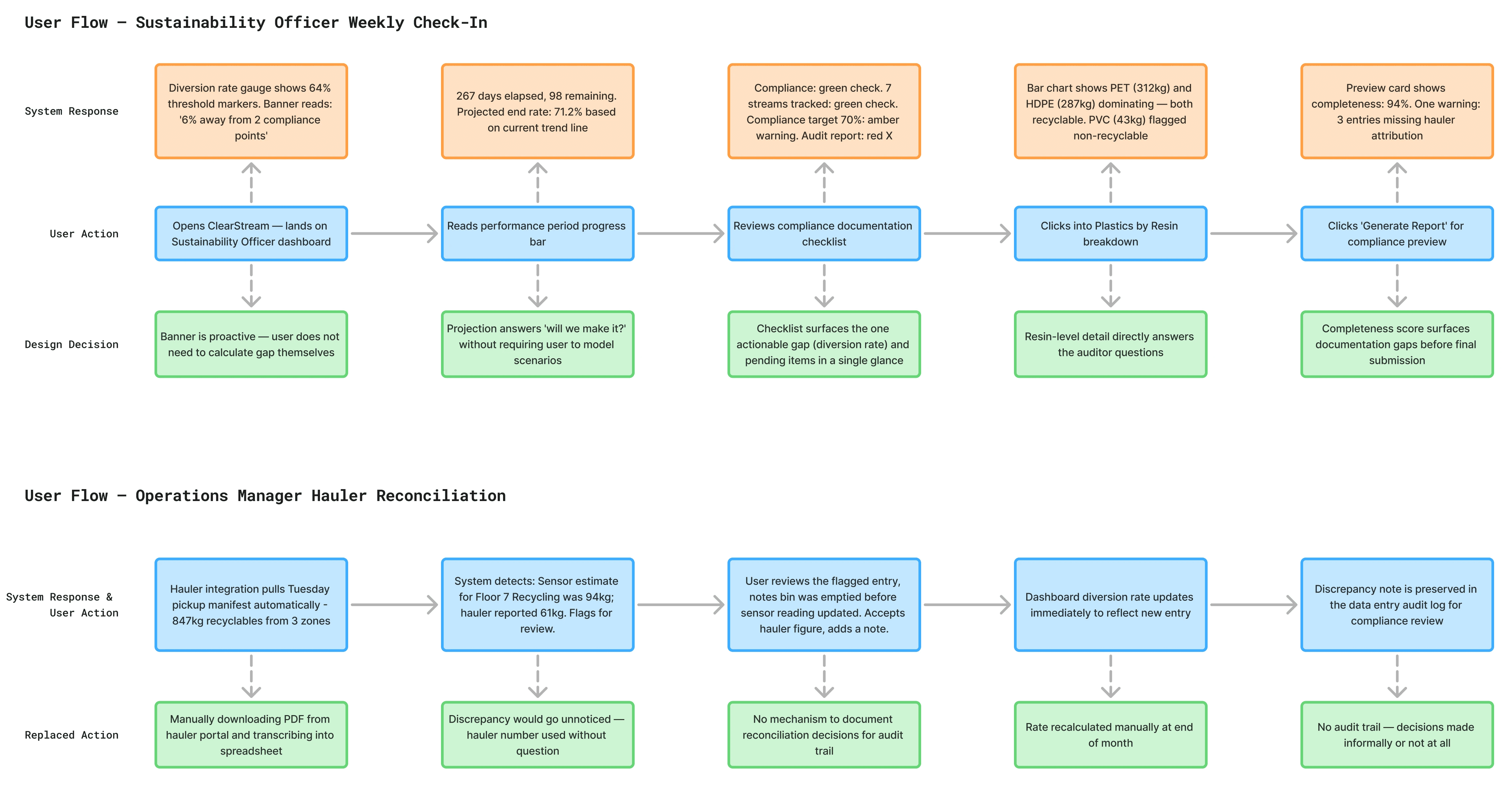
Four core features were developed through two rounds of collaborative design workshops with research participants, followed by low-fidelity prototype testing and one round of mid-fidelity usability testing before final design.
Real-Time Diversion Rate Dashboard
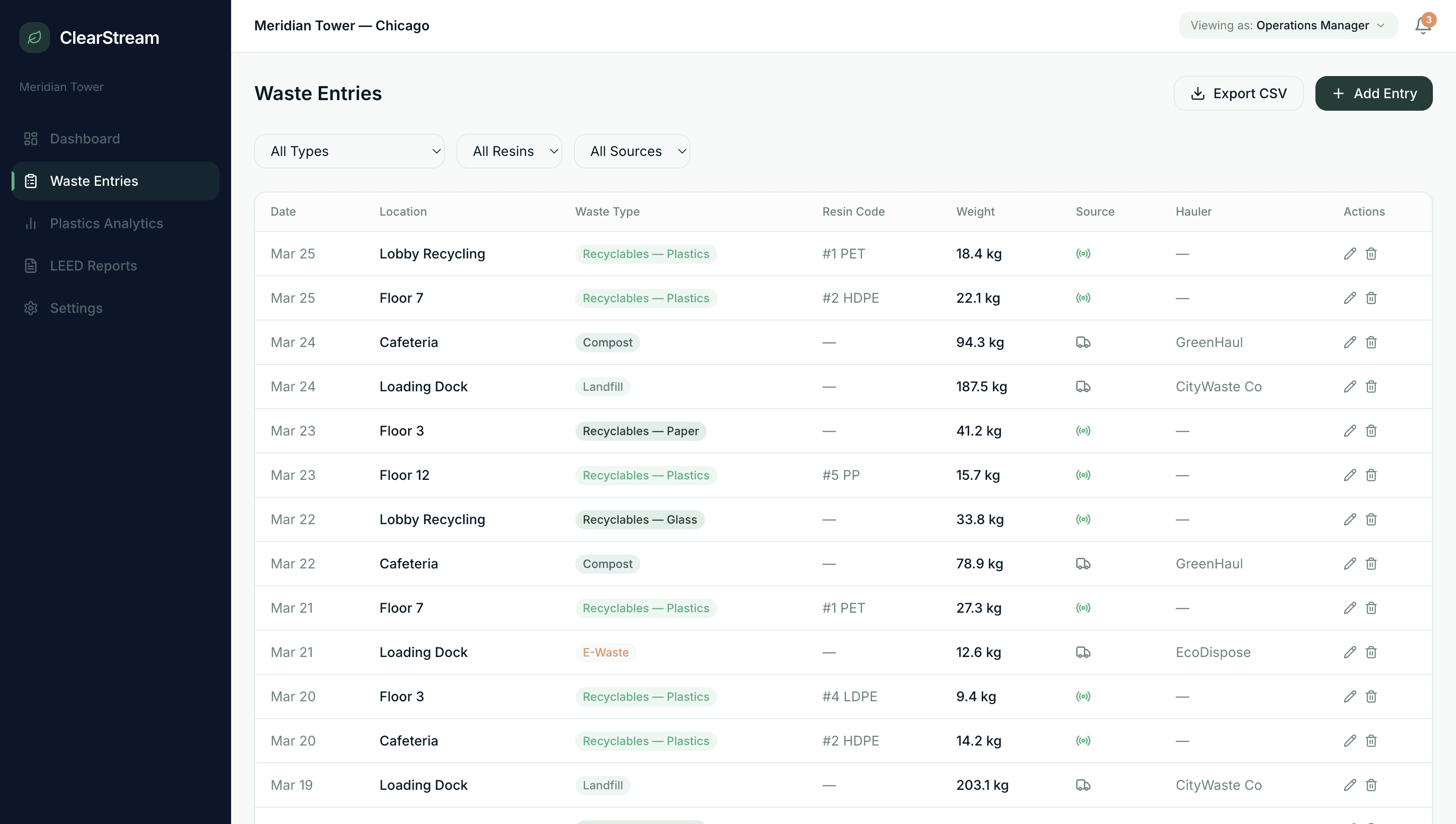
Plastics Tracking by Resin Type
Unified Data Ingestion Layer
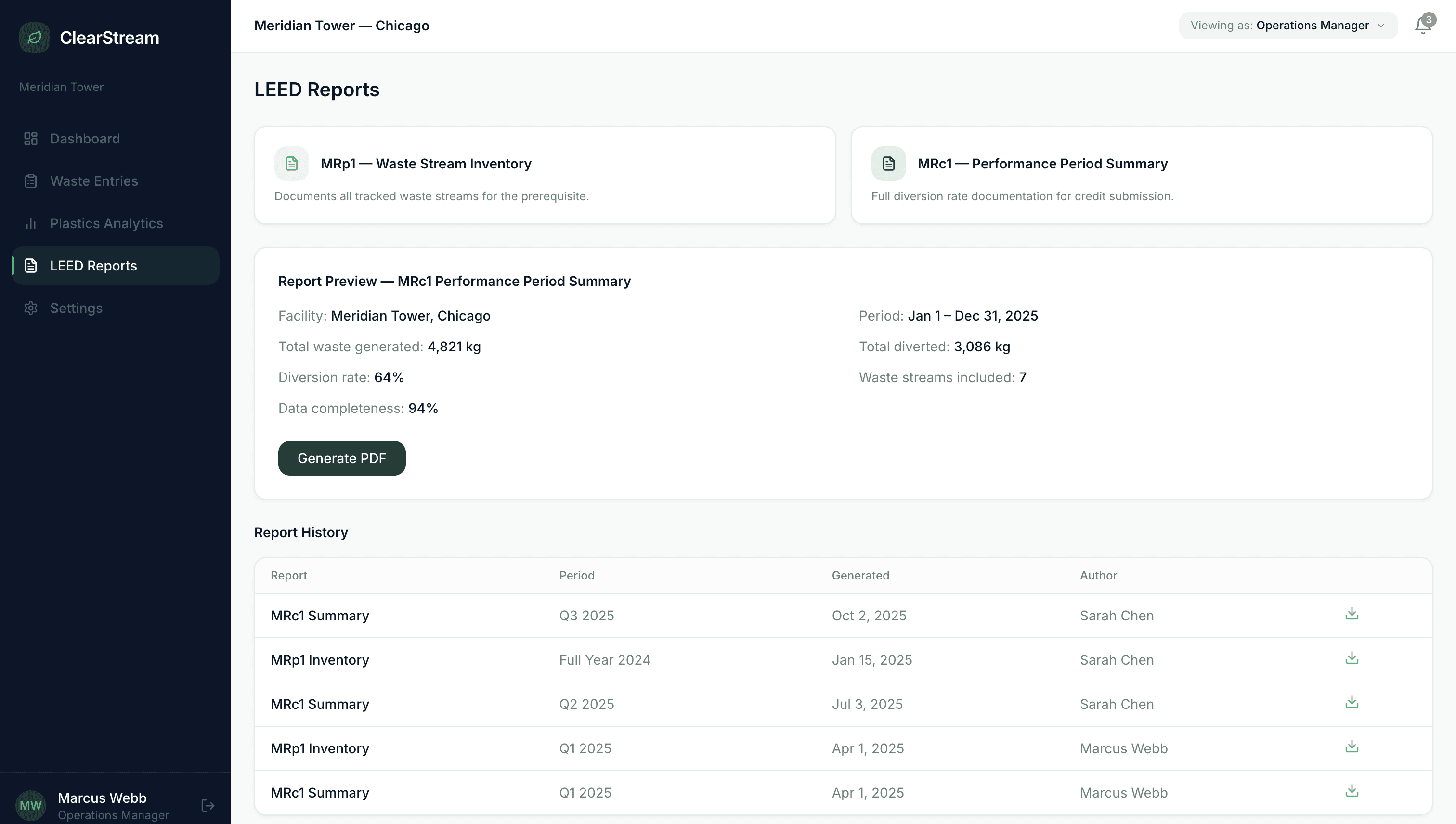
Compliance Report Generation
Usability Testing
One round of moderated usability testing with 10 participants (6 operations managers, 4 sustainability officers).
Key findings:
Task: Identify current diversion rate and determine LEED point projection — avg completion time 11 seconds (target was under 20 seconds)
Task: Add a plastics waste entry with correct resin code — 9/10 completed without error after conditional resin field was added in prototype round 2
Task: Generate a compliance report and identify the data completeness gap — 8/10 completed; 2 participants did not notice the completeness score until pointed to it
Most common feedback: 'I want to be able to see this on my phone' — noted as a Horizon 2 feature requirement
SUS (System Usability Scale) score: 83.2 — above the 'good' threshold of 80
ROI & Metrics
Projections are based on baseline data from research participants, document review of historical compliance submissions, and measured task-time improvements from usability testing. A 6-month post-launch measurement period will validate these projections.
Projected Outcomes: 6 Months Post-Launch
< 2 hrs
< 4 hrs
94%
40%
Next Steps