UX of Second Life Products
Product | Circular Systems Design | B2C
Product
Circular Intelligence, B2C Product
Role
Systems Thinker
Time Duration
3 months
Description
We live in a world where supply chains can track a package down to the hour, where manufacturing is optimized to the millisecond, and where customer acquisition strategies are engineered with surgical precision. Yet the moment a product is returned, all that sophistication collapses. At the same time, e-waste is now one of the fastest-growing waste streams globally, fueled by a culture that equates “new” with “trustworthy” and by products increasingly designed for short lifespans. Brands want to recapture value. Regulators want transparency. Sustainability is no longer optional, and affordability has become a necessity.
The world is quietly asking for a better model but the system wasn’t architected for one. About how redesigning the UX of second-life products, the information, transparency, and emotional experience surrounding refurbished electronics, could help rebuild trust, reduce waste, and unlock billions of dollars in trapped value. About why our products have two lives, and why only one of them is designed to succeed.
Read Here
Problem Statement
Shoppers are unable to trust refurbished products as there is a lack of transparency of their condition.
Problem Statement

Systems Map
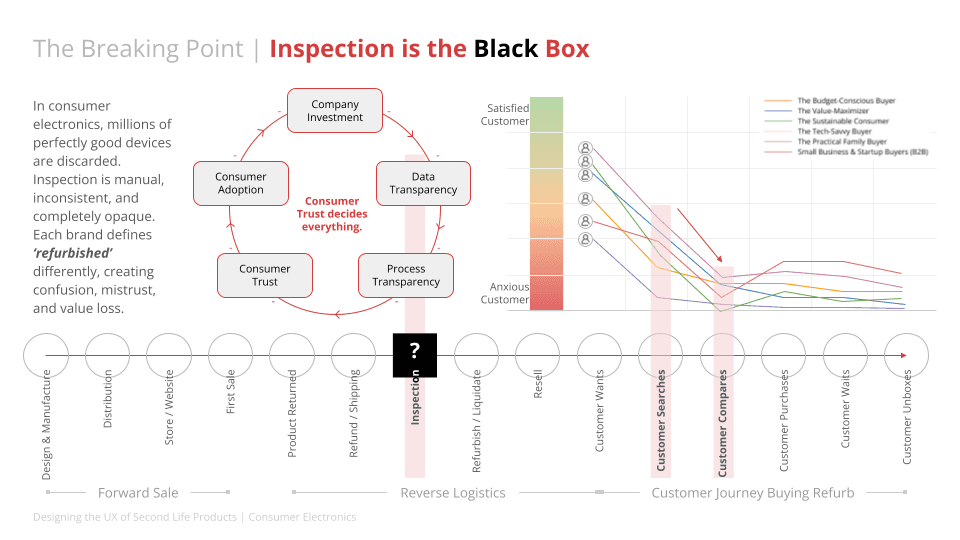
The root of the problem isn’t technological. It’s structural.
The Transparency Blackhole
>>
Implication
Recent studies found that consumers first anchor on confidence-building signals, retailer reputation, brand recognition, and perceived quality before they even begin comparing price, warranty, or product features. Only after trust is established do shoppers evaluate the rational factors: cost, hardware specs, warranty length, and expected performance. In other words, trust is the gateway to every other decision.
The Cannibalization Myth
>>
Implication
If consumers hesitate to buy refurbished, brands hesitate to promote it and for reasons that are more emotional than strategic. Inside most organizations, “refurbished” is treated as a brand liability, something to tuck behind a support page or outsource quietly to third-party liquidators. This anxiety has shaped the refurb market for years. The irony is that the very thing brands fear, losing new-product customers, is the thing that only happens when refurbished is done poorly. When refurb is done well, with transparency and grading standards and real warranties, it strengthens brand equity instead of weakening it. It signals confidence. It builds credibility. It expands the market rather than cannibalizing it.
Forces in the Ecosystem
Regulation Is Forcing Transparency and Repairability
Returns Are a Multi-Billion Dollar Margin Sink
Consumers Want Sustainable Options but Don’t Trust Them
Inspection & Traceability Tools Finally Exist
Warranty, Repair, and Data Laws Are Raising the Bar
E-Waste Is the Fastest-Growing Waste Stream
Today’s Refurb Programs Still Fall Short
The entire refurb market runs on trust in individual brands, not on shared standards. Apple can promise “like new” because of its reputation and tight control. Amazon Renewed relies on the Amazon guarantee, not a transparent grading rubric. Best Buy’s open-box grading varies by store. eBay introduces stricter seller rules, but grading is still subjective and seller-dependent.
Across these programs:
No one shares detailed repair or inspection history.
No one uses a standardized grading rubric adopted across the industry.
No one provides lifecycle transparency at the unit level.
No one connects refurb data back to product teams to prevent future returns.
The Human Side: Who Buys Refurb & Why They Still Hesitate
The Intervention | A Standardized Refurbishment Grading & Transparency System
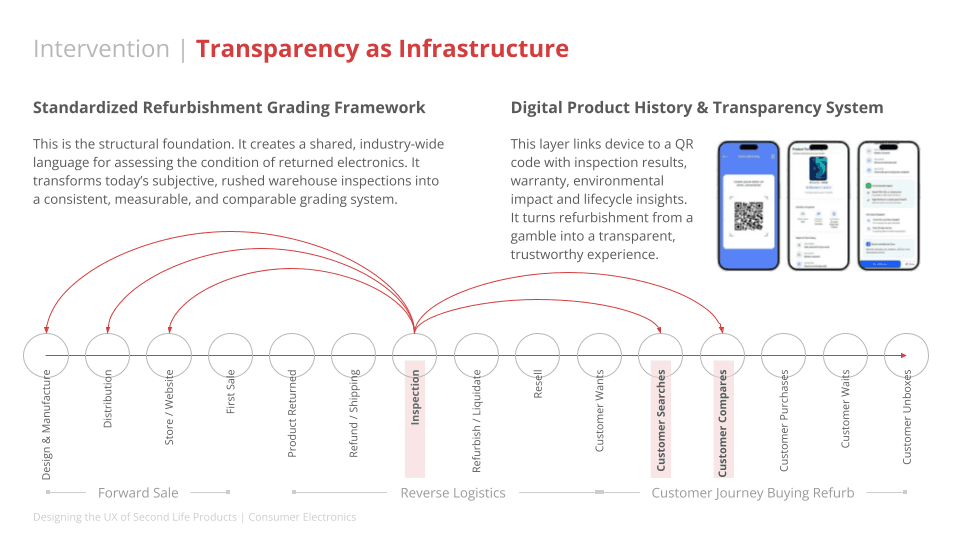
For most consumers today, buying refurbished electronics feels like a gamble. When every refurbished device comes with a digital product history, the refurb experience shifts from mysterious to trustworthy. A simple QR scan reveals its journey from manufacturing to first ownership to refurbishment and recommendations on its second life use cases, just like a vehicle history report.
This transparency doesn’t just reduce fear, it builds confidence. Customers can now match products to their personal use cases. Buying refurbished becomes guided, intentional, and informed. As a result, the emotional experience transforms. Instead of feeling like they’re settling for a cheaper alternative, consumers feel like they’re making a smart and informed choice, one that saves money, reduces environmental impact, and still offers the quality and reliability they expect. Trust becomes built into the buying journey, and the act of choosing refurbished becomes not a compromise, but a confident decision.