VizArQA : A Foundation for Visual Question Answering inArchitectural Simulation
Research Paper | AI Design Research | B2B / B2C
Product
Research Paper + AI Copilot for early architectural design
Role
Product Builder, Research Assistant
Time Duration
1 Year
Description
Vision-language models (VLMs) offer potential for automated interpretation support, yet their reliability on architectural simulation outputs remains unexplored, particularly across different computational scales. This study introduces VizArQA, a benchmark for evaluating VLM performance on architectural environmental simulation interpretation. We evaluate six models representing both open-source and closed-source approaches across varying computational scales: GPT-5, GPT-5-Mini, and GPT-5-Nano, alongside Qwen3-235B, Qwen3-8B, and Qwen3-2B. Results show performance variations across model sizes and architectures, with larger models achieving substantially higher accuracy. These findings establish baseline performance metrics for VLM-assisted environmental analysis and highlight the potential of AI-assisted workflows, potentially enabling a path toward integrating VLMs into design processes to enhance efficiency, insight generation, and accessibility for non-experts.
Read Here
Problem Statement
Environmental simulations are critical in early-stage design, offering insights into factors like solar radiation, airflow, and climate responsiveness. However, interpreting these simulation outputs is time-consuming and requires expert reasoning, which can slow down design workflows.
Excerpts
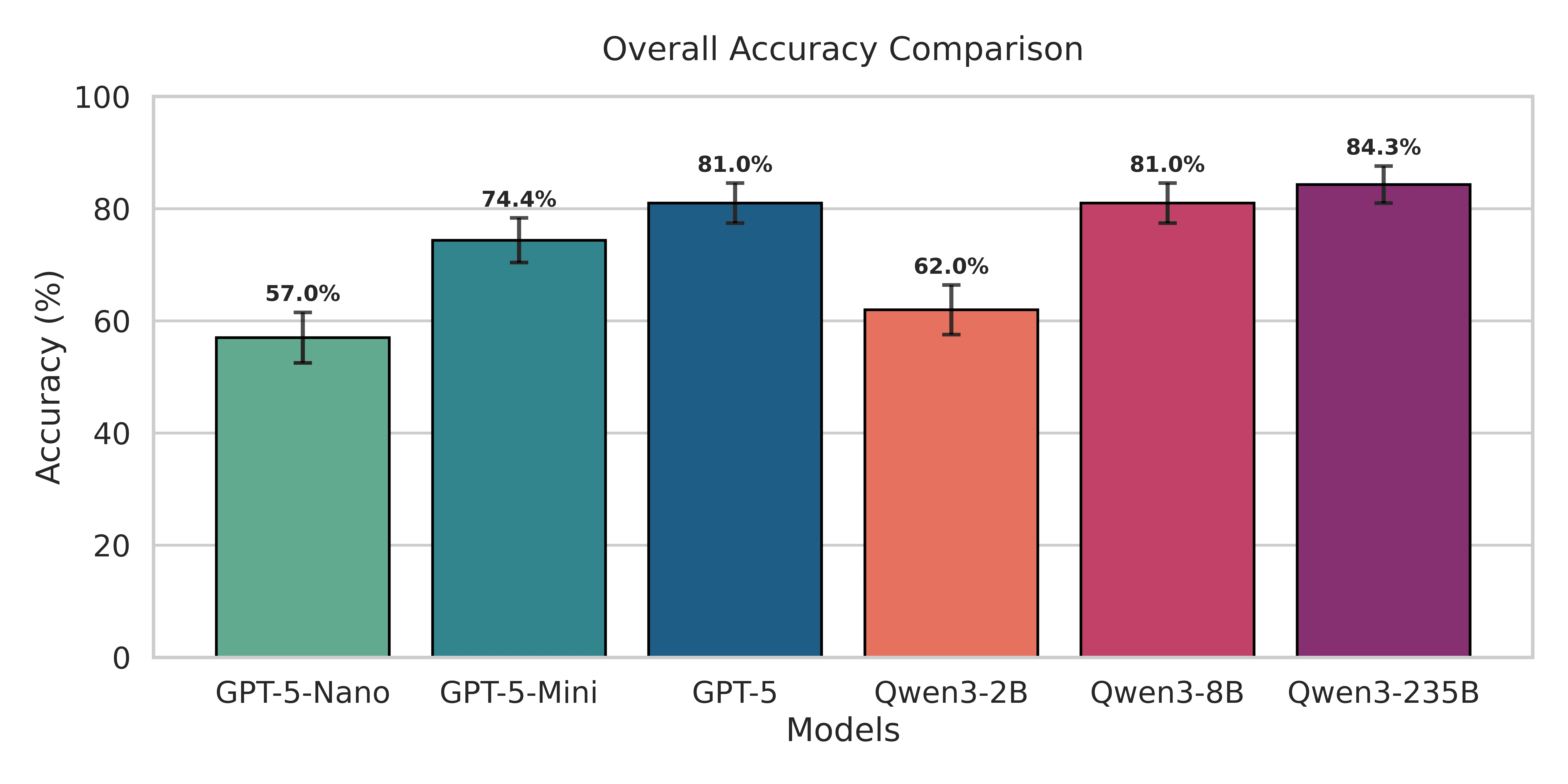
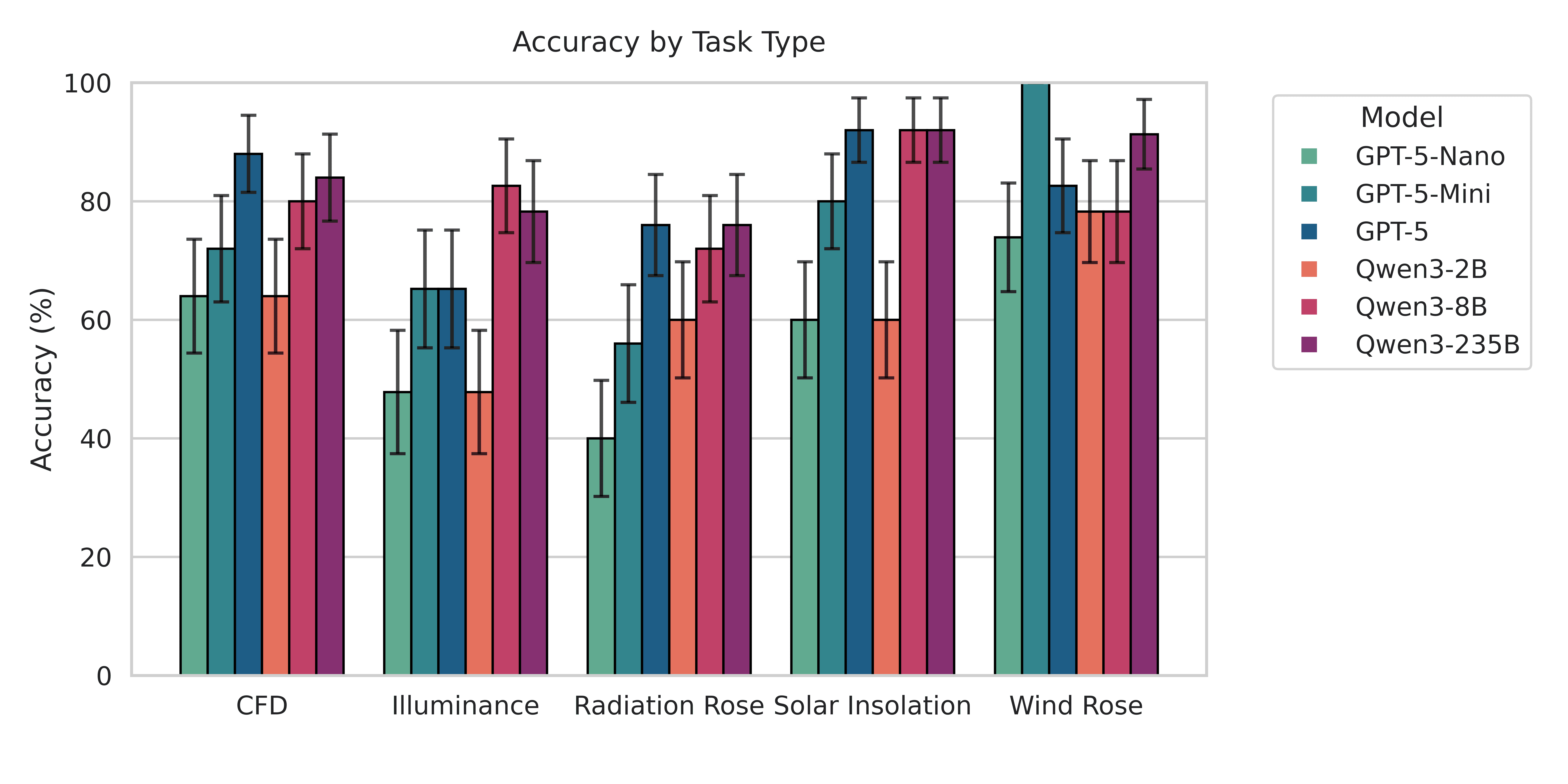
Our evaluation showed performance variations across VLMs in environmental simulation interpretation tasks. Overall accuracy ranged from 57.02% to 84.30%, establishing clear performance hierarchies between model architectures and computational scales as shown in Figure 7. The largest model, Qwen3-235B, achieved the highest accuracy at 84.30%, followed closely by both GPT-5 and Qwen3-8B at 80.99%. Mid-range models GPT-5-Mini (74.38%) and Qwen3-2B (61.98%) demonstrated moderate performance, while GPT-5-Nano, achieved 57.02% accuracy. Performance patterns revealed distinct advantages for larger model architectures in complex visual reasoning tasks. Open source models (Qwen3 series) demonstrated competitive performance with closed-source alternatives (GPT-5 series), with Qwen3-235B surpassing all GPT-5 variants. This finding suggests that architectural simulation interpretation capabilities scale effectively with model size across both proprietary and open-source frameworks, potentially democratizing access to AI-assisted environmental analysis workflows.